
Italy Art Theft Reported at Museum Near Parma as Paintings Stolen
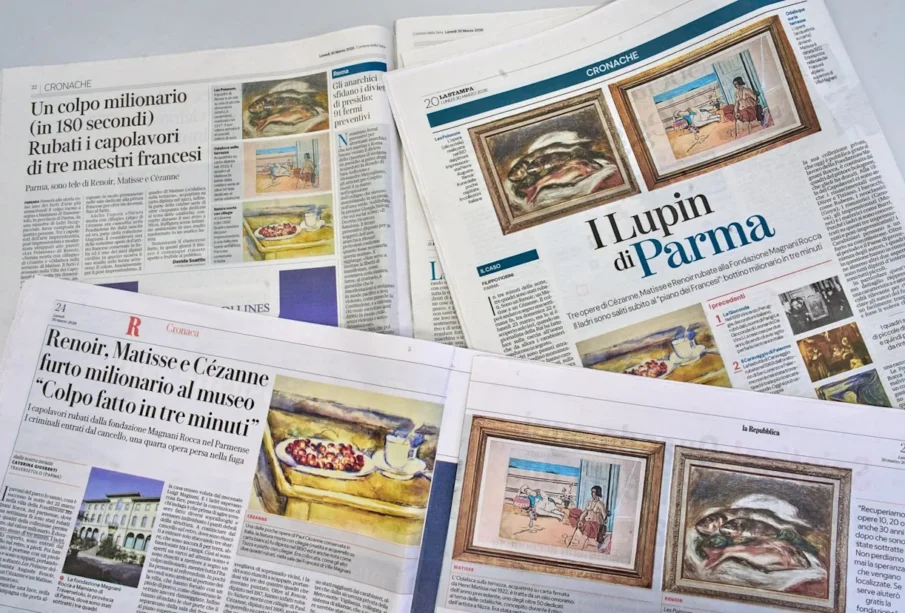
Authorities in Rome have confirmed an art theft involving three valuable paintings by renowned artists. Thieves took the works from a private museum near Parma in northern Italy. The incident happened overnight between March 22 and 23. It has raised fresh concerns about security in European cultural institutions.
Police reported that the suspects forced entry into the Magnani Rocca Foundation. This respected museum sits about 20 kilometers from Parma. Once inside, the thieves acted fast.
They took less than three minutes to remove the artworks. After that, they fled through the surrounding gardens. Investigators believe the speed and precision show careful planning. The evidence points to an organized group behind the art theft.
Stolen Works and Investigation
The stolen pieces include “Fish” by Auguste Renoir, “Still Life with Cherries” by Paul Cézanne, and “Odalisque on the Terrace” by Henri Matisse. Experts value these works at millions of euros. However, they note that the pieces do not rank among the most famous creations by these artists.
Art historian Claudio Strinati shared his view on the theft. He explained that Renoir’s painting looks appealing but does not stand as a major highlight in the museum’s collection. Even so, the loss still matters. The foundation holds a strong reputation in the art world. It opened in 1977 and houses works by major figures. These include Albrecht Dürer, Peter Paul Rubens, Anthony van Dyck, Francisco Goya, and Claude Monet.
Despite the alarm system activating during the break-in, the suspects escaped before security forces arrived. Authorities responded quickly, yet the thieves had already disappeared. As of Monday, the museum had not released a public statement. Officials also remained unreachable because the institution stayed closed.
Meanwhile, investigators continue to examine possible motives. They are considering whether the crime involves a ransom demand. Strinati explained that some art theft cases connect to extortion. In such cases, criminals use stolen works as bargaining tools. They later demand money or favors in exchange for returning the items. Authorities now treat this as a possible line of inquiry.
In addition, the incident reflects a wider pattern across Europe. Several museums have faced similar risks in recent years. Criminal groups continue to test security systems and exploit weaknesses. Even well-protected institutions struggle to prevent such fast and targeted attacks.
For example, a separate case last year involved a major theft at the Louvre Museum. Reports stated that thieves stole items worth tens of millions of euros. That incident also raised alarms about security gaps in top-tier museums. As a result, experts have called for stronger protection measures.
At the same time, Italian police have intensified their efforts. Officers are working to track the stolen paintings. They are also trying to identify the individuals responsible. Investigators are reviewing security footage and gathering evidence from the scene. Each step aims to bring clarity to the case.
Ultimately, this latest art theft highlights ongoing risks to cultural heritage sites. Museums hold valuable and irreplaceable works. However, they remain vulnerable to determined criminals. Authorities must now balance public access with stronger protection. The challenge continues as institutions seek better ways to safeguard their collections.



Leave a reply


 It seems that Mr. Bridgerton is not the only one swept up in a romance#bridgerton #bridgertonseason400:23
 Mr and Mrs Bridgerton #bridgerton #penelope #theprimemag00:07
 That classic sibling energy where "I’m sorry" actually means "I’m going to do it again #zendaya00:19
 The groom is here #robertpattinson #thedrama #edwardcullen #moviepremiere #funnymoment00:36
 #rihanna and #asaprocky looking great in #paris #theprimemag00:20
 #ElizabethOlsen and #AnthonyMackie on the red carpet00:09
 #SelenaGomez stepped out for the Rare Beauty Matte Foundation launch on Thursday00:17
 #cardib performance yesterday in #vegas #Valentines2026 #lustremagazine00:11
 #CardiB #WholesomeChaos #ProtectTheCrow #FunnyMoment #CelebrityMoments00:07
 They never told you about this Golden Globes gaffe with #JenniferLopez and #JeremyRenner00:11
 #bridgerton #netflix #trending #viral #misspossy #bridgertonseason401:17
 He definitely got it🤩🔥#onechallenge #thewoahchallenge #tiktok #dancetrends #hiphop #dancers00:18
 Oh No! 😂 #funny #relatable #trending #memes00:08
 #LeBron has made a major impact off the court his commitment to education and his community01:01
 😂😂 #memes #baby #fun #funny #trending00:08
 The only time #Shaq really went one-on-one with #LeBron #shaquilleoneal #lebronjames00:29
 Shaq did this on live tv… 😂 #shaq #insidethenba #charlesbarkley #shaquilleoneal #nba00:17
 You just know Kendrick’s heart dropped before he laughed 😭 #shaq #ShaquilleO’Neal00:10
 #nickiminaj or #cardib . That’s a tough one for #50cent 😂00:13
 #sofiavergara in #ModernFamily: #Sofía #Sitcom #FamilyComedy #funny #TVSeries01:00
 #SofíaVergara when asked about arrest on #TheEllenDeGeneresShow 😂00:20
 #Steve Harvey and #shaq on an episode of Family Feud #funny #theprimemag00:57
 #CillianMurphy fake laugh became the focus of the conversation on Jimmy Kimmel Live #theprimemag00:15
 Moment #KatyPerry surprised Benjamin Glaze with a kiss during his American Idol 2018 audition00:37
 #SelenaGomez and music producer #BennyBlanco00:13


The Prime is a dynamic publication delivering the latest in entertainment, lifestyle, culture, sports and world news, bringing sharp insight, fresh perspectives and stories that matter to a global audience.
