
US Republicans Introduce New Plan to End Government Shutdown
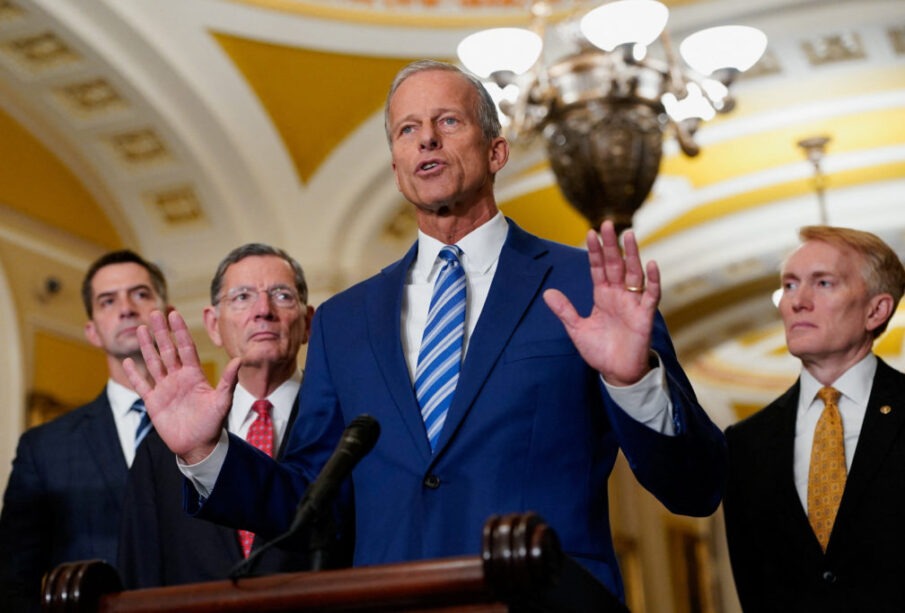
U.S. Senate Majority Leader John Thune (R-SD) speaks to reporters as Senate Republican leaders hold a press conference following their weekly policy lunch and weeks into the continuing U.S. government shutdown, on Capitol Hill in Washington, D.C., U.S., October 15, 2025. REUTERS/Elizabeth Frantz
Republicans in the United States Congress have introduced a new plan to resolve the ongoing government shutdown. The move raises fresh hopes that the crisis could end within days. Lawmakers have faced weeks of political tension, and the shutdown has disrupted key services across the country. Now, this proposal signals a possible breakthrough as pressure continues to mount on both parties.
The deal, confirmed by House Speaker Mike Johnson and Senate Majority Leader John Thune, presents a clear funding strategy. Leaders designed the plan to fund the Department of Homeland Security through two separate spending measures. Under this structure, one bill will handle general operations. A second bill will focus on Immigration and Customs Enforcement and Customs and Border Protection.
Lawmakers believe this split approach could simplify negotiations. It allows Congress to address key concerns in smaller sections rather than one large bill. As a result, leaders hope to gain broader support and move the process forward more quickly.
Political Tensions and Travel Disruptions
The government shutdown has already created visible disruptions across the country. Major airports have reported staffing shortages within the Transportation Security Administration. Consequently, travellers now face longer wait times at security checkpoints. These delays show how the shutdown continues to affect daily life beyond political debates in Washington.
Republican leaders have also responded to directives from President Donald Trump. They stated that lawmakers will act soon to ensure full funding for border related agencies. According to their joint statement, the plan aims to resolve disagreements while protecting national security operations.
However, not all lawmakers support the proposal. Senate Democratic leader Chuck Schumer criticised the move. He argued that Republicans stepped back due to internal divisions. Democrats have continued to push for changes to immigration enforcement policies. In particular, they want reforms tied to recent unrest linked to immigration operations.
Meanwhile, negotiations have remained tense and complex. Both parties continue to search for enough support to pass a bill through a narrowly divided House and Senate. The process has slowed further after Republicans rejected a funding proposal that had already passed the Senate with full backing.
At the same time, pressure has increased on lawmakers to act quickly. Earlier, President Trump urged Republican leaders to present a funding bill before June. He emphasised the need to prioritise border security agencies. In addition, he suggested using a legislative path that could avoid delays caused by Senate rules. These rules often allow the minority party to slow or block major decisions.
The new proposal reflects a clear attempt to break the deadlock. By separating key funding areas, lawmakers aim to make compromise easier. This approach could help Congress agree on at least part of the broader budget while continuing discussions on more complex issues.
Even so, uncertainty still surrounds the outcome. Lawmakers must now introduce and debate the plan in both chambers. The coming days will determine whether this strategy can gain enough support to pass.
For now, attention remains firmly on Congress. If lawmakers approve the proposal, they could restore full government operations. Such a move would ease pressure on federal workers, reduce travel disruptions, and stabilise affected agencies. Ultimately, the success of this plan will depend on whether both parties can move past divisions and reach a practical agreement.




Leave a reply


 It seems that Mr. Bridgerton is not the only one swept up in a romance#bridgerton #bridgertonseason400:23
 Mr and Mrs Bridgerton #bridgerton #penelope #theprimemag00:07
 That classic sibling energy where "I’m sorry" actually means "I’m going to do it again #zendaya00:19
 The groom is here #robertpattinson #thedrama #edwardcullen #moviepremiere #funnymoment00:36
 #rihanna and #asaprocky looking great in #paris #theprimemag00:20
 #ElizabethOlsen and #AnthonyMackie on the red carpet00:09
 #SelenaGomez stepped out for the Rare Beauty Matte Foundation launch on Thursday00:17
 #cardib performance yesterday in #vegas #Valentines2026 #lustremagazine00:11
 #CardiB #WholesomeChaos #ProtectTheCrow #FunnyMoment #CelebrityMoments00:07
 They never told you about this Golden Globes gaffe with #JenniferLopez and #JeremyRenner00:11
 #bridgerton #netflix #trending #viral #misspossy #bridgertonseason401:17
 He definitely got it🤩🔥#onechallenge #thewoahchallenge #tiktok #dancetrends #hiphop #dancers00:18
 Oh No! 😂 #funny #relatable #trending #memes00:08
 #LeBron has made a major impact off the court his commitment to education and his community01:01
 😂😂 #memes #baby #fun #funny #trending00:08
 The only time #Shaq really went one-on-one with #LeBron #shaquilleoneal #lebronjames00:29
 Shaq did this on live tv… 😂 #shaq #insidethenba #charlesbarkley #shaquilleoneal #nba00:17
 You just know Kendrick’s heart dropped before he laughed 😭 #shaq #ShaquilleO’Neal00:10
 #nickiminaj or #cardib . That’s a tough one for #50cent 😂00:13
 #sofiavergara in #ModernFamily: #Sofía #Sitcom #FamilyComedy #funny #TVSeries01:00
 #SofíaVergara when asked about arrest on #TheEllenDeGeneresShow 😂00:20
 #Steve Harvey and #shaq on an episode of Family Feud #funny #theprimemag00:57
 #CillianMurphy fake laugh became the focus of the conversation on Jimmy Kimmel Live #theprimemag00:15
 Moment #KatyPerry surprised Benjamin Glaze with a kiss during his American Idol 2018 audition00:37
 #SelenaGomez and music producer #BennyBlanco00:13


The Prime is a dynamic publication delivering the latest in entertainment, lifestyle, culture, sports and world news, bringing sharp insight, fresh perspectives and stories that matter to a global audience.
